Inside the Atelier: How a Silk Shawl Is Born
Step inside Gamze Haberal's Bodrum atelier and follow the journey of a hand-painted silk shawl — from blank canvas to finished work of art.
ONE of SILK
4/8/20263 min read
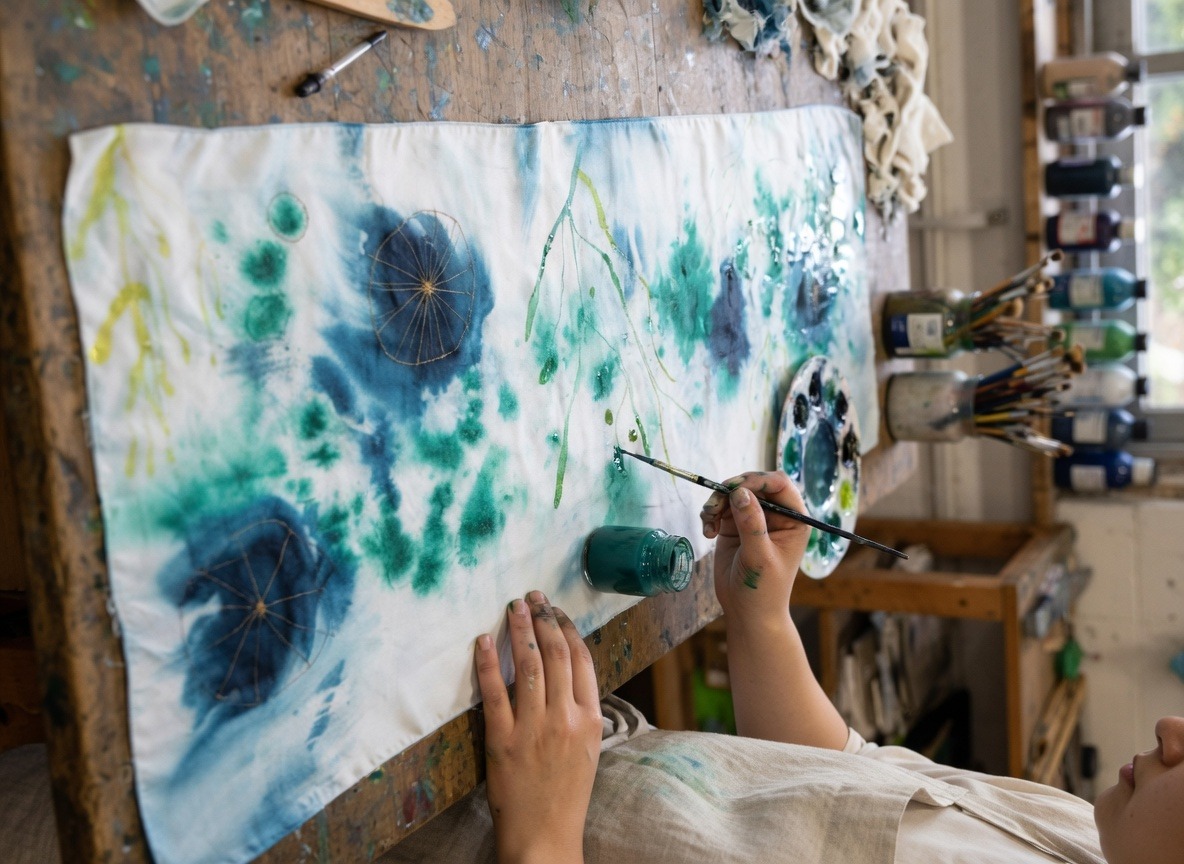
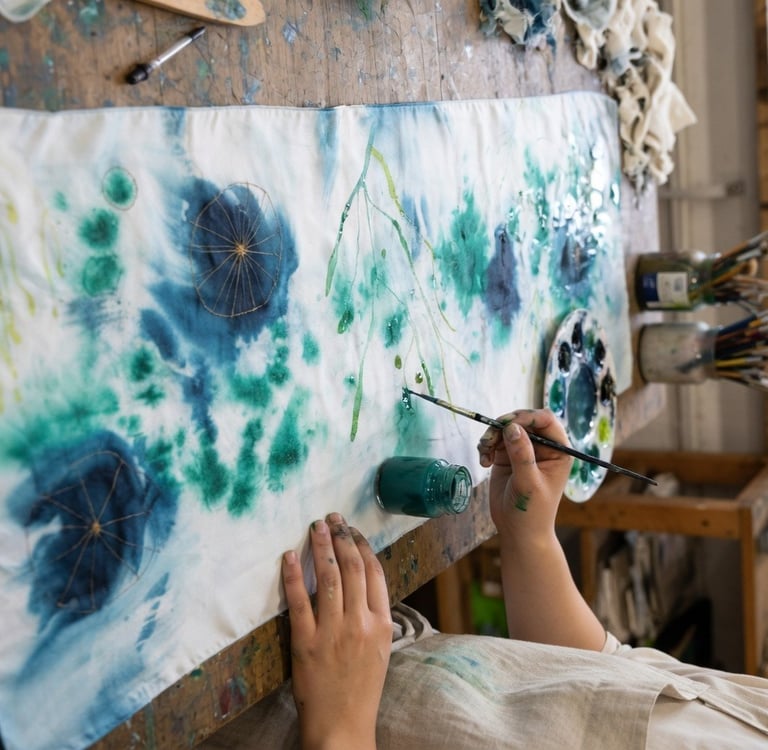
There is no factory. There is no pattern department, no repeat print, no production run. There is an atelier in Bodrum, a length of pure mulberry silk stretched across a table, and an artist with a brush in her hand.
This is how every ONE OF SILK piece begins — and this is how it ends: as a singular object that did not exist before this specific morning, and will never exist again in quite this form.
The Silk Arrives Blank
Before anything else, there is the silk itself.
Each piece begins as a length of 100% pure 9 momme mulberry silk — ivory white, unwashed, carrying the natural warmth of the fiber before any pigment has touched it. At 75 × 200 centimeters, it is generous enough to drape, to wrap, to move with the body. Spread flat across the atelier table, it is simply a surface — luminous, waiting, completely open.
Gamze Haberal does not begin with a sketch. She does not transfer a design from paper to silk, does not follow a pre-planned composition. She begins by looking at the silk — at its particular quality of light on that day, at the way it falls and pools at the edges of the table. Then she begins.
The First Mark
The first brushstroke on blank silk is a commitment. Unlike paper, silk does not forgive overworking. Unlike canvas, it absorbs pigment immediately and distributes it outward from the point of contact in ways that are guided but never entirely controlled. The artist and the material are in conversation from the first moment — and like any good conversation, neither party dictates the outcome entirely.
This is the quality that makes hand-painted silk impossible to replicate. The spread of a wet wash across 9 momme mulberry silk is a physical event — governed by the moisture in the fiber, the weight of pigment in the brush, the angle of the stroke, the temperature of the atelier that morning. Change any one of these variables and the result changes. Change all of them — as every new session inevitably does — and you have a different painting entirely.
Every ONE OF SILK piece is painted in a single session. Gamze does not return to a piece the following day to add details or correct passages. What happens in the atelier stays exactly as it happened.
Color and Instinct
The palette for each piece is not chosen in advance from a color chart. It emerges from the composition as it develops — from the way one color calls for another, from the balance of warm and cool, from the particular energy of the work as it takes shape on the silk.
The pigments themselves are silk-specific dyes — formulated to bond permanently with the protein structure of the silk fiber rather than sitting on its surface. Once set, they are light-fast and wash-fast. They become part of the silk, not a coating on top of it.
In the Bodrum atelier, color is mixed directly on a palette or sometimes on the silk itself — allowing two wet pigments to meet and blend within the fiber rather than before they reach it. This wet-on-wet technique produces the characteristic soft edges, organic gradients, and unexpected interactions of color that define the ONE OF SILK aesthetic.
The Details That Take the Longest
The broad washes of color — the teal blooms, the emerald forests, the abstract rivers of blue — are often the fastest part of the process. It is the details that require time.
The fine ink stems of the bougainvillea series, drawn one by one with a brush barely wider than a thread. The individual florets of a wisteria cluster, each one a separate mark, accumulated into the soft mass of the whole. The precise calligraphic lines that connect the poppies in "The Poppy Dance" — drawn in a single continuous movement from top to bottom, without hesitation and without revision.
These details are not decoration added to a finished composition. They are the composition — the evidence of a human hand working with complete attention, at the scale at which attention becomes visible.
The Edges
When the painting is complete and the pigments have been set and fixed, the shawl moves to the hands of a specialist artisan for its final finish: the hand-rolled hem.
Each edge is folded by hand to a precise width and stitched with a single thread — slowly, stitch by stitch, around the full perimeter of the 75 × 200 centimeter piece. This is not a detail that can be rushed or replicated by machine. The result is a soft, rounded edge that gives the silk its characteristic fluid drape and marks the piece, quietly and unmistakably, as something made entirely by human hands.
From the Atelier to You
When the hem is complete, the shawl is folded with care, wrapped in tissue, placed in a signature black presentation box, and sealed with a ribbon. It travels from Bodrum — or from Istanbul, where Gamze maintains a second atelier — directly to its owner, via FedEx Express, tracked and insured at every stage.
From blank silk to delivered painting: this is the journey of every ONE OF SILK piece. No two journeys produce the same destination. That is, precisely, the point.
Discover the current collection at oneofsilk.com